False River Is the Backdrop. Main Street Is the Itinerary.
August 27, 2026
August 27, 2026
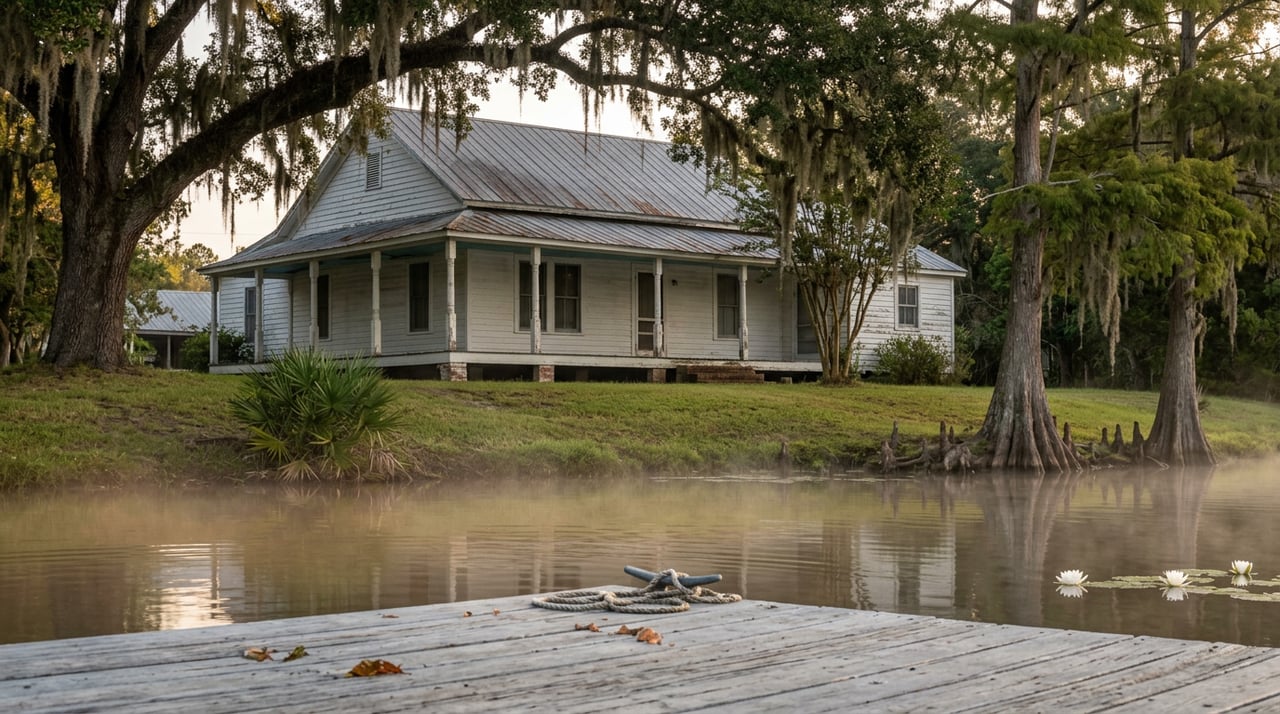
Every postcard rack from Oscar to the Audubon Bridge sells the same shot of New Roads: glass-still water at sunset, a cypress silhouette, the oxbow lake doing its best impression of the Mississippi it used to be. It's a real view and it earns the film. But ask anyone who actually lives here how they spend a Saturday between September and Thanksgiving, and the lake barely comes up. The real circuit runs on land, down a ten-mile stretch of LA Highway 1 lined with three centuries of local history, and through three days of closed streets on Main Street every fall. The water is scenery. The itinerary is somewhere else entirely.
Most self-guided history trails put you behind a rope or a museum placard. The False River Historical Trail puts you in Melanie Bueche's front yard, looking at an oak tree.
The tree isn't marked with much fanfare, which is sort of the point. Ernest J. Gaines, the New Roads-born author of The Autobiography of Miss Jane Pittman, used to rest under that same tree as a boy walking the highway to and from the store. Decades later he'd come back to sit under it again, and Bueche remembers watching a man in a beret pointing a camera crew toward her yard before she knew who he was. That's stop one on a roughly ten-mile route that runs from Lakeland into downtown New Roads along Highway 1, passing Parlange Plantation and Bergeron's Pecan Plant before reaching the Riverlake property, once home to Julien Poydras, more than a century before anyone thought to put up a sign about it.
The signs themselves are a newer addition than the history they mark. A researcher named Kevin Cicero mapped the trail's stops years after the original markers had quietly disappeared, and it took a Police Jury president and a local funder putting money behind new signage before most residents realized the route had been sitting there the whole time, unmarked, running past their own commutes. It's a good reminder that a lot of what makes this town interesting isn't hidden. It's just never been labeled.
You can drive the trail in under an hour. Most people don't. A bike, or a slow evening walk with a dog, is the better pace for reading historical markers you'd otherwise blow past at 45 miles an hour.
The trail eventually spits you out at the north end of the lake, near City Hall, where the actual water-based part of a New Roads weekend lives. It's smaller and less curated than the postcard suggests.
None of this requires a festival or a reservation. It's just infrastructure the town has quietly maintained for the people who already live around it, which is a different thing than infrastructure built to be photographed.
If the trail and the launch are the quiet version of a New Roads weekend, the Harvest Festival on False River is the loud one, and it's the closest thing the town has to a civic reunion.
The current festival dates back to 2011, but it's really a third act. Pointe Coupee Parish ran an agricultural fair as far back as 1914, let it lapse for a decade, brought it back in 1975 as the Festival de la Pointe Coupee, and eventually rebuilt it into the Harvest Festival as a way to keep the parish's agricultural roots visible to people who no longer farm for a living. Last fall's run, October 31 through November 2, followed the pattern the festival has settled into over the past several years: three days on Main Street, a Friday evening parade, carnival rides, arts and crafts vendors, and a live music schedule that in 2025 included Keith Frank, Group Therapy, and Rockin' Doopsie across two stages. Saturday morning belongs to the Sugar Rush 5K and Walk, which starts at 9 a.m. on West Main Street before the crowds thicken.
The logistics tell you something about scale. The city closes entry and exit to three specific points, one at St. Mary Street by St. Mary of False River Catholic Church, one at Court Street near the courthouse, and one on New Roads Street, with overflow parking sent to the Pointe Coupee Parish School Board office on Napoleon Street. That's not small-festival crowd control. That's a town rerouting itself around its own Main Street for a weekend.
The exact dates shift by a week or two year to year, landing somewhere between mid-October and early November, so it's worth checking the festival's own site closer to the date rather than penciling in last year's calendar. What doesn't shift is the fact that it happens on Main Street, not at the lake, which tells you where the town still considers its actual center to be.
A festival weekend empties into restaurants that don't need a festival to stay busy. Ma Mama's Kitchen runs closer to fine dining, with a wine and liquor list built for lingering and enough private space to handle the overflow crowd after a parade. Morel's Restaurant leans into Southern cuisine with a modern edit and has built a following on its views as much as its soul food. Jarreau's Restaurant, a longtime fixture that recently refreshed its menu, closes Mondays and keeps its own rhythm regardless of what's happening downtown. And Tiger Drive Inn, unpretentious and cash-register casual, still pulls loyal regulars back for a Bengal Burger they've been ordering for decades, the kind of place where the value isn't the plating, it's the fact that it hasn't changed much.
None of these are festival pop-ups. They're the places locals eat on a random Tuesday, which is exactly why they're worth knowing before the one weekend a year when everyone in town is trying to get a table at once.
If you're new enough to New Roads that the postcard version still feels true, give it one October. The lake will still be there, still worth a sunset walk down Morrison Parkway. But the actual texture of a fall weekend here runs past a stranger's oak tree, down a pecan plant's driveway, and into three days of closed streets on Main. The water photographs well. The land is where the town actually lives.
If you're thinking about what it takes to put down roots in a town built around a Main Street instead of a shoreline, Caleb Jackson knows the difference between the two better than most. Reach Out Today.
Stay up to date on the latest real estate trends.
Born and raised in Baton Rouge, I've built my business across Zachary, St. Francisville, New Roads, and the Felicianas. Most of my clients come from people I've already closed for, and the people they send me. That's not an accident. It's the result of pricing straight, marketing hard, and negotiating harder on every deal.
CALEB JACKSON
ADDRESS 37325 MARKET PL DR PRAIRIEVILLE, LA 70769